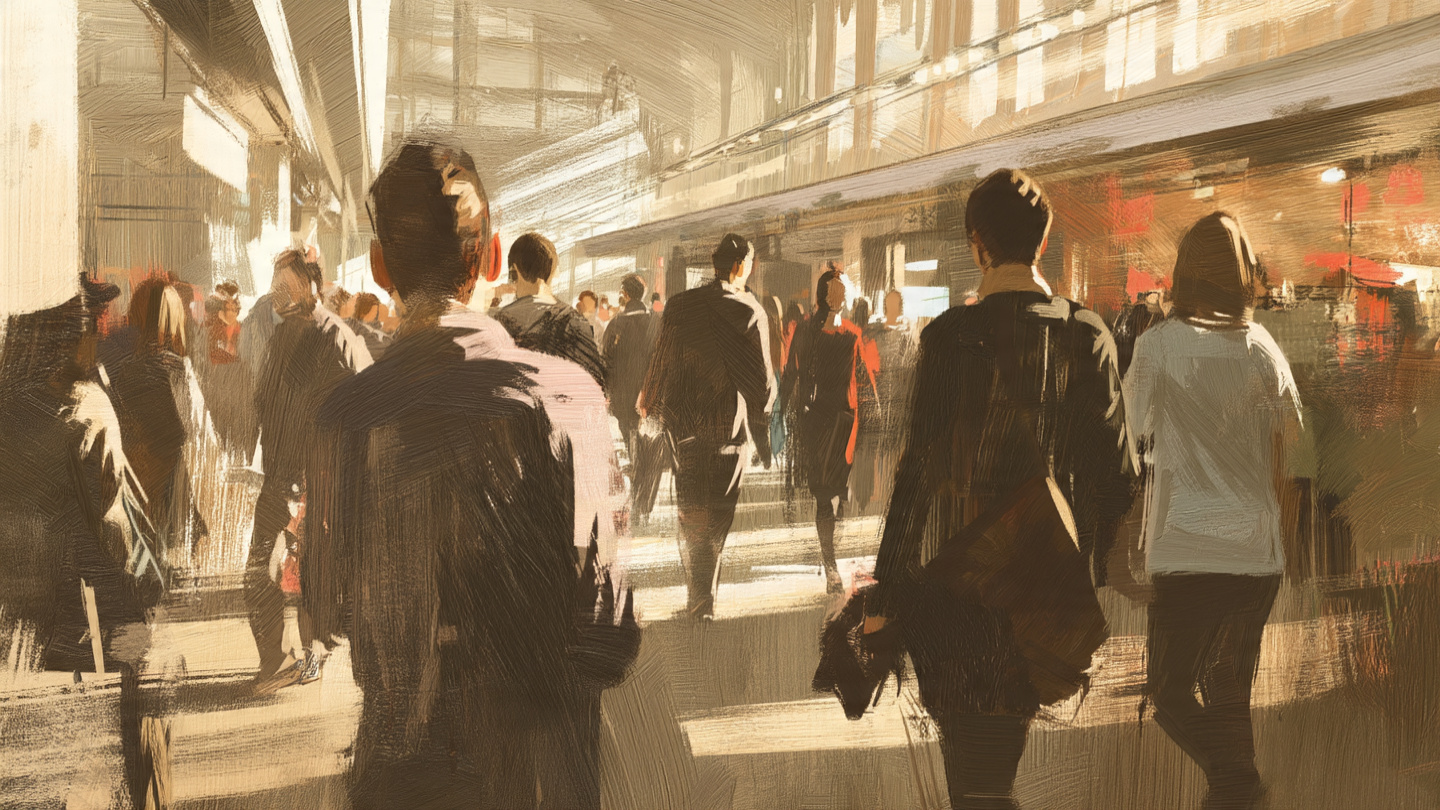
In Japan, there is a phrase — 空気を読む, kuuki wo yomu — that translates literally as 'reading the air.' It means picking up on the unspoken expectations of a situation: knowing what is appropriate without being told, sensing what the group needs before anyone says it, adjusting your behaviour to fit the invisible but very real requirements of the moment.
Foreigners often learn this phrase as a social nicety, a cultural quirk. It's more fundamental than that. Reading the air is not just a politeness skill in Japan. It's the primary coordination mechanism of the entire society — and it does the work that written rules and formal enforcement do in Western systems.
Two ways to coordinate behaviour
Every society faces the same basic problem: how do you get large numbers of people to behave in ways that allow collective life to function? Western systems solved this primarily through explicit rules. Laws are written down, enforced by institutions with formal authority, and in principle apply equally regardless of who you are or what the group thinks. If you follow the rules, you've done your part.
Japan solved the same problem differently. The primary coordination mechanism is social expectation — what the situation requires, what the group implicitly demands, what a person of appropriate sensitivity would naturally do. The rule isn't written; it's in the air. And the enforcement isn't institutional; it's social. Step outside what the air demands and you don't get a formal sanction. You get exclusion, coldness, the withdrawal of cooperation. Which, in a high-trust interdependent society, is often more powerful than a fine.
Why this makes Japan extraordinarily functional
In ordinary life, the air-based system produces something remarkable. Japanese public spaces are clean not primarily because of fines but because littering violates the air. Trains run on time not primarily because of contractual penalties but because lateness violates the air. Customer service is exceptional not primarily because of corporate policy but because poor service violates the air. The coordination happens before the formal system even needs to engage.
This is genuinely impressive. Western rule-based systems require constant enforcement infrastructure — inspectors, penalties, litigation — to produce outcomes that Japanese social expectation achieves almost automatically.
Where it breaks down
The weakness appears wherever the air itself becomes misaligned with reality. In a rule-based system, a bad rule can be challenged, argued against, repealed. The mechanism for changing rules is explicit and available. In an air-based system, changing what the air demands requires shifting collective social expectation — a much slower, more resistant process with no formal procedure.
When the air demands that problems not be named, problems don't get named.
When the air demands that a failing policy be continued because changing it would involve someone losing face, the policy continues. When the air demands loyalty to a direction that everyone privately knows is wrong, the direction holds. The same invisible system that makes daily life so smooth becomes, in moments of collective crisis, exactly the thing that prevents correction.