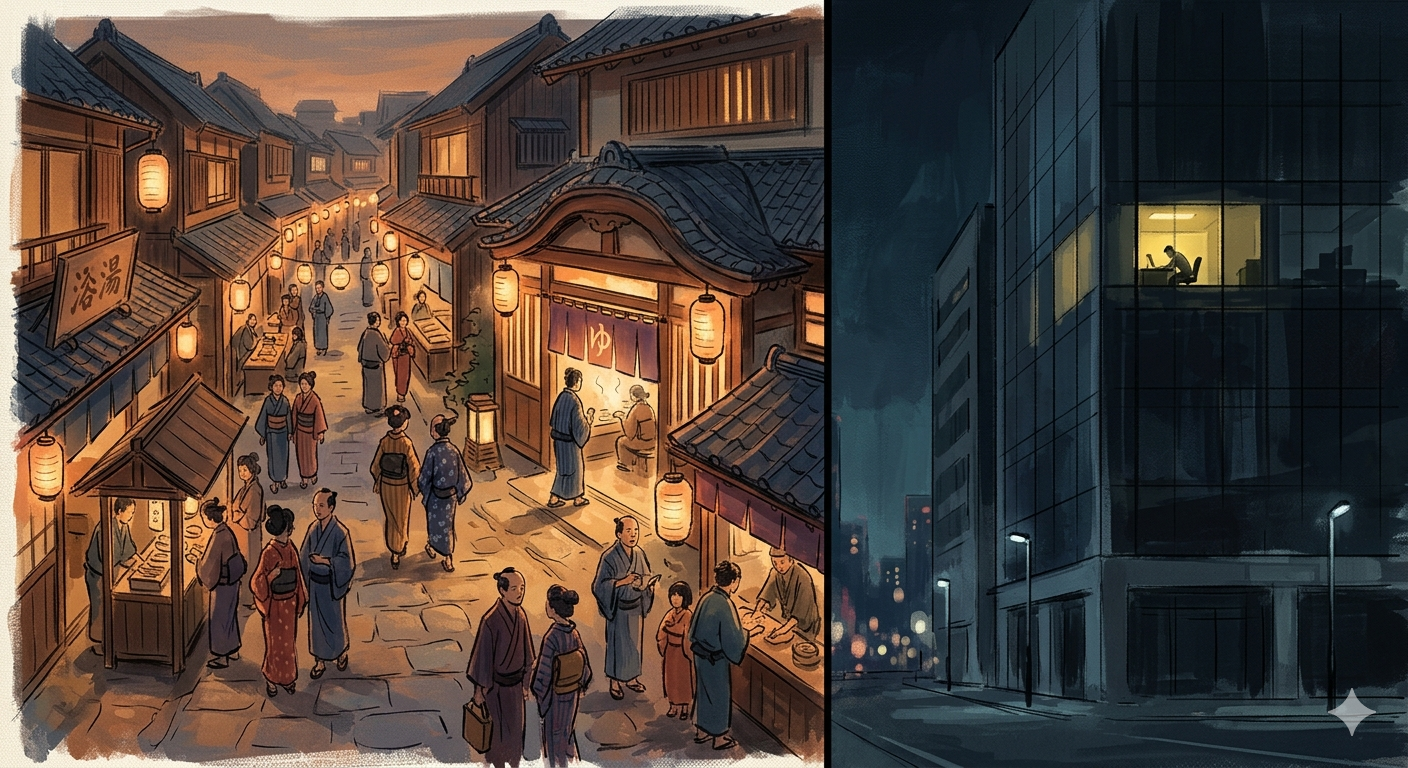
Japan today has one of the highest rates of work-related stress, overwork deaths (karoshi), and social isolation in the developed world. It's also one of the most technologically advanced, economically prosperous, and objectively safe societies in human history. So why do so many people in modern Japan seem quietly miserable?
Life in Edo
The Edo period (1603–1868) was, by most modern standards, materially hard. Average lifespans were short, sanitation was primitive, medicine was limited. And yet accounts from the period describe a social richness that contemporary Japan seems to have lost. Townspeople in Edo-period cities had a vibrant culture of neighbourly exchange — festivals, communal baths, shared craft guilds, and a deep sense of local belonging. People knew their neighbours. They had roles in their community. They belonged to something.
What modernisation took
The Meiji Restoration and the post-WWII economic miracle gave Japan prosperity, safety, and global status. They also replaced the tight-knit community unit with the company and the nuclear family. The salaryman model optimised for economic output at the cost of community, leisure, and personal meaning. The community bath gave way to the private shower. The neighbourhood festival became a spectator event. Belonging became conditional on productivity.
The paradox of progress
This is a version of a broader human problem: the things that make material life better often dissolve the social structures that make life feel meaningful. Modernity trades community for convenience. Privacy for comfort. Ritual for efficiency.
The question Edo Japan raises is whether there's a version of prosperity that keeps what worked about pre-modern community — the rootedness, the mutual obligation, the shared meaning — while shedding what didn't. It's a question Japan is slowly starting to ask again, as declining birth rates and a loneliness epidemic make the cost of the salaryman model impossible to ignore.