There's a question that quietly sits underneath almost every argument about East versus West, collectivism versus individualism, authoritarianism versus democracy: why do whole civilisations think so differently from each other?
The usual answers — religion, economics, historical accident — feel true but incomplete. Here's a theory that goes a layer deeper: it's the land that did it.
Two kinds of geography, two kinds of mind
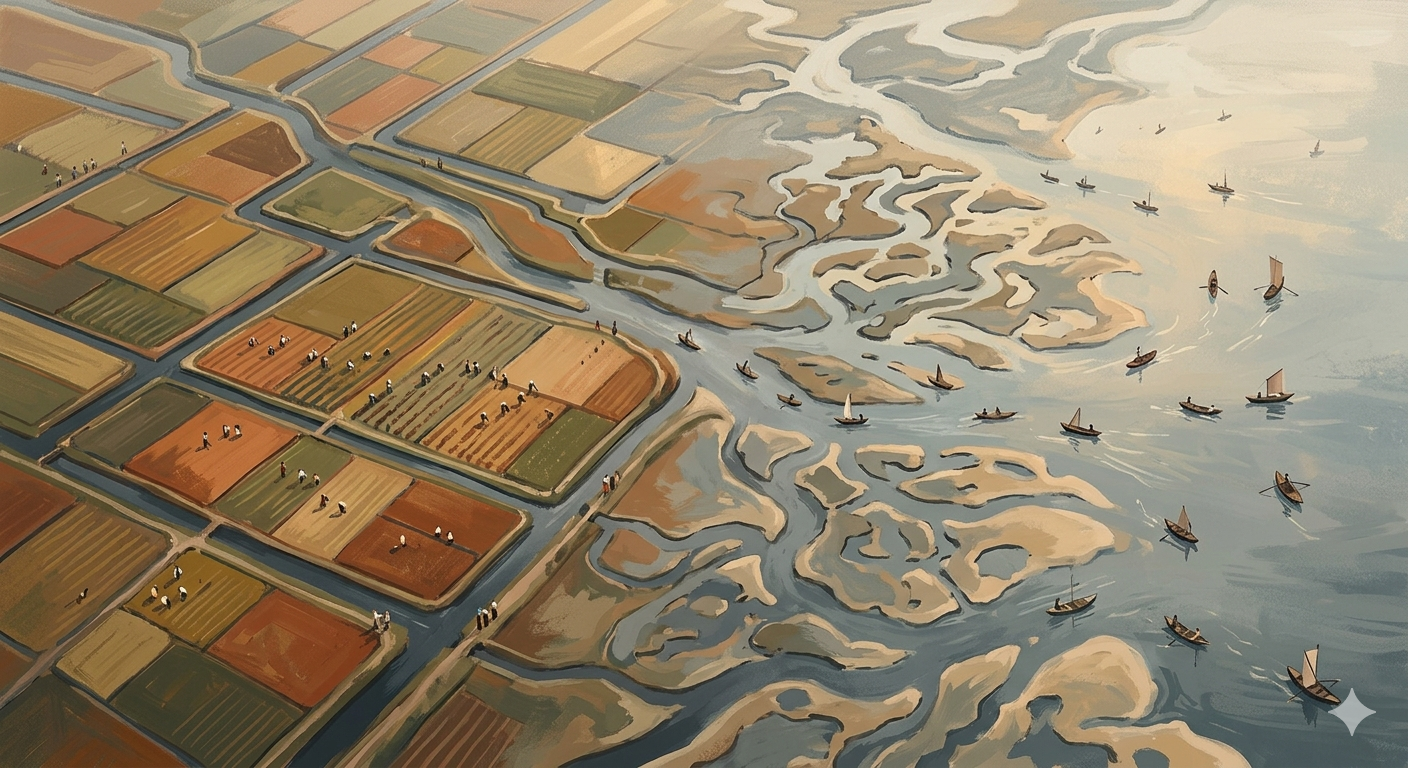
Picture the great floodplain civilisations. The Nile. The Yellow River. The Ganges. The Tigris and Euphrates. These are places where agriculture required coordination on a massive scale. You couldn't just plant your field and ignore your neighbours — the whole community either managed the flood together or everyone starved.
The result, over thousands of years, was a particular kind of society. Hierarchical. Rule-following. Harmonious by necessity. Obedience wasn't oppression — it was survival. The person who broke from the collective, who refused to dig the irrigation ditch on time, wasn't being bold. They were a threat to everyone's food supply.
Now picture the fractured-sea civilisations. Ancient Greece. Phoenicia. Medieval Italy. Japan's coastal domains. These were places broken up by mountains, islands, and open water. There was no central river feeding everyone. Each city-state, each domain, each island had to fend for itself.
The result was competition. Lots of it. City-states competed with each other, which meant they had to innovate to survive. Merchants gained power because trade was the only way to get what you couldn't grow. Individuals with unique skills and ideas could build reputations that transcended their birthplace.
The person who challenged the norm wasn't dangerous — they might be your next competitive advantage.
This isn't just ancient history
The patterns embedded in those ancient landscapes are still shaping how people think today — often in ways that feel completely natural from the inside but baffling from the outside.
Why do many East Asian work cultures prize harmony and consensus so deeply? Because ten thousand years of floodplain agriculture selected hard for the person who cooperated. The instinct runs deep.
Why does the West produce so many contrarians, disruptors, and start-up founders? Because the fractured landscape — literal and metaphorical — rewarded the person who found a new angle. That instinct runs equally deep.
This doesn't mean one is better. Floodplain cultures built some of the most stable, lasting civilisations in history. The pyramids. The Great Wall. The Confucian administrative system that ran China effectively for two thousand years. These aren't small achievements. They require a social technology — call it coordinated compliance — that the fractured-sea world often lacks.
Fractured-sea cultures produced explosive innovation, democratic philosophy, and global trade. They also produced an enormous amount of war, instability, and inequality. Freedom without coordination has costs too.
What happens when the two meet
The most interesting — and often most tense — moments in history happen when floodplain and fractured-sea cultures collide. Japan's Meiji Restoration. China's encounter with Western colonialism. The relationship between modern multinational corporations (deeply Western in structure) and their Asian subsidiaries.
The clash isn't really about values, even though it feels like it. It's about incompatible survival software, built for incompatible environments, now running in the same room.
The floodplain person hears the fractured-sea person's directness and reads arrogance. The fractured-sea person reads the floodplain person's indirect communication and suspects dishonesty. Neither is right. They're just running different operating systems.
Why this matters right now
As the world gets more connected, the collision between these two deep-rooted cultural logics isn't going away — it's accelerating. Supply chains, international politics, multicultural cities: all of these are places where floodplain and fractured-sea instincts meet daily and often misunderstand each other.
Understanding the geography that made each culture isn't just an intellectual exercise. It's one of the most practical tools we have for actually making sense of why people behave the way they do — and for finding the patience not to pathologise what is simply different.